


Description
The harmonica is a free reed instrument of the aerophone group.
Description of the instrument
The harmonica consists of several reeds arranged transversely and in parallel on wooden slats that function as a support. The cover of the instrument is usually made of sheet metal, and serves to give shape and strength to the instrument, as well as to protect the tabs that remain inside.
Way of playing
By blowing on the edge of the holes, we vibrate the reeds. It can be blown or breathed in, giving two different tones in the same position.
History
Although we do not have documentation, we know that this instrument has been very widespread among us. The musicians have not been professionals but in many cases, they have reached a very high level. According to some, at the beginning of the 20th century it spread throughout Europe and its appearance meant, among others, the decline in the use of the mouth harp-horn.
About the denomination we can say: aho-soinua, filarmonika, filarmunika have been the most common s. In the Navarra area of Larraun it is called ezpainetako-soinua and in Leitza we picked up the peculiar of xotixe.
It has been played in the kitchens of houses, bars and closed places to sing and dance. In Iribas (Navarra) we met Periko Garaikoetxea, from the Martikonea house. This one, in the middle of the XX century, every Sunday, after the religious services of the "vespers" he played for the young people to dance. In summer, in good weather, he would stand in front of the portal and they would dance in the house era, and in winter, inside, at the great entrance of the house. From a very young age he had been blind and with great skill and care he played everything by ear. His repertoire was very wide and he took it from the musicians (txistularis, accordionists ...) who came to play at the patron saint festivities. Dances "loose", marches, "held" and others. Among the songs we recorded for him is the particular of Iribas's "Silla dantza" that he played (Beltrán, 1996, p. 91).
SOURCES
Bibliography
BELTRAN ARGIÑENA, Juan Mari. (1996). Soinutresnak euskal herri musikan. Hernani: Orain.
Discography
LANDA, Marcos. (1991). Albisturko aho-soinua. IZ. IZ-376.
Image gallery


Audio
FANDANGOA
Iribasko Periko Garaikoetxea itsuak 1950 eta 60ko hamarkadetan bere ezpainetakoarekin igande eta jaiegunetan haur eta gazteentzat dantza saioak eskaintzen zituen. Fandango hau Juan Mari Beltranek 1979an grabatu zion saioetatik hartu dugu. Jatorrizko hiru buelta eta erdiko ezpainetako hutsezko pasartedun bertsioari panderetaren erritmo lagungarria erantsi diogu.
Soinulariak: Periko Garaikoetxea (ezpainetakoa), Juan Mari Beltran (pandereta)*.
* Larraungo herri-dantzak (2016) disko-liburua; 54. or. eta CDko 7. pieza.
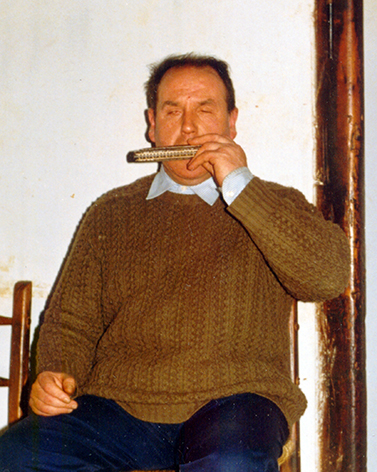
Periko Garaikoetxea. Iribas, 1979. (Arg.: JMBA)
MARTXA ETA JOTA
Seberino Onaindia Landeta (Gernika, 1920-2012) gizon sendoa izanik, borroka librean aritu zen eta Espainiako txapelduna izan zen. Baina kirolagatik ezaguna bazen ere, bere umoreak bihurtu zuen Seberino hain ezagun Bizkaiko zati handi batean. Hamaika txiste kontatzen zekien (asko berak sortutakoak), eta horrekin batera, bere asmakizunek, istorio xelebreek, pentsaera filosofikoak eta kontari bikaina izateak egin zuten hain ezagun. Euskararekiko zaletasun handia zuen, eta umoreaz landa, bere jakituria agertzen zuen hainbat berben jatorria erakutsiaz. Irakurzalea zen, baita kantari ona ere errepertorio zabal batekin, eta harmonika/mosukitarra trebetasun handiz jotzen zuen. Azken harmonika, Txikito de Bolibar zestalari trebeak oparitu zion, Ameriketan erosia: Hohner Comet markakoa (Alemanian egina), ertz batean Do tonalitatekoa eta bestean Solekoa.
Seberino Onaindiak jotako martxa eta jota hauek Gernikan grabatu ziren 2003ko abenduaren 29an*.
* Juan Mari Beltran, Manu Gojenola eta Ander Barrenetxea hirukoteak grabatu zuen, 2003ko abenduaren 29an, Seberino bizi zen Gernikako Juan Calzada Zaharren Egoitzan.
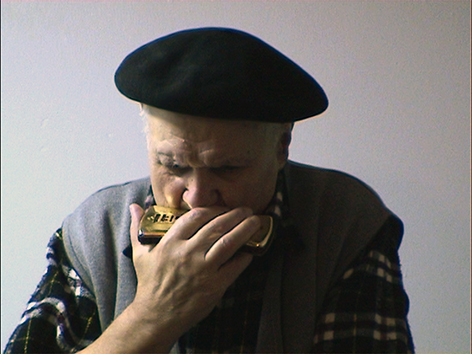
Seberino Onaindia aho-soinua jotzen. Gernika, 2003/12/29 (Arg.: Filmatutako bideotik hartua)
FANDANGOA ETA ARIN-ARINA
Markox Landa hasieran eta gero semeen laguntzarekin, Albizturko Landatarrak urteetan ibili dira plazaz plaza soinu-tresna hau jotzen. Hirukote honek 1991an disko bat grabatu zuen pieza zaharrekin eta Markoxek sortutako berriekin. Hemen aukeratutako fandangoa eta arin-arina Oiartzunen 2007ko abenduaren 29an HM Neguko kontzertuan eskaini zuten saiotik hartu dugu.
Soinulariak: Landa Aita-semeak. Albizturko aho-soinua. Markox Landa (aita), Aitor Landa eta Markox Landa (semea).
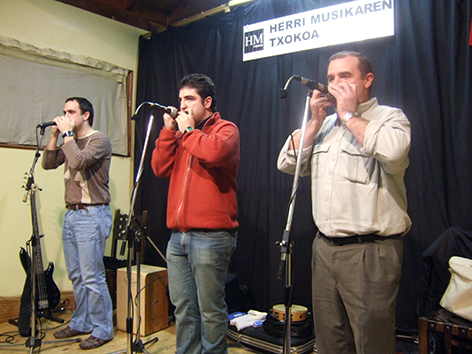
Landatarrak HM Neguko Kontzertuan. Oiartzun, 2007/12/29. (Arg.: Soinuenea)
Fandangoa. Periko Garaikoetxea. Iribas, 1979.
Full sheet
- Number:
- 59
- Classification:
- Aerophones -> Reeds -> Single Free
- Notes:
- Harmonica (aho-soinua, ezpainetako-soinua, xotixe, filarmonika)


