


Description
The xirolarru-bota or bagpipe belongs to the aerophone group.
Description of the instrument
The bota bagpipe (xirolarrua) has the following parts: melodic pipe, roncón, skin for air and blowpipe.
- The melodic pipe is of the dulzaina type, made of boxwood, with a double reed mouthpiece, made of cane.
- The roncón is a cylindrical boxwood tube manufactured in 3 parts, turned with different diameters on the outside. It has a simple reed, of the alboka type, and gives a continuous low note. You can have yarn tassels and pendants for decoration.
- Skin for air. The boot (zahato), which gives the instrument its , is made of goat leather or similar, and lined with a fabric cover on the outside.
- Soplete (blowpipe). It is usually made of boxwood, except for the tip, which is usually made of bone or horn. It has a small leather valve at the end that goes into the wineskin. This opens to allow air to pass through when blowing, and closes tightly when not blowing.
Way of playing
He takes the wineskin for the air under his arm, the roncón over his back and the pointer in his hands, he puts the torch in his mouth and plays. It is blown into the torch, introducing the air into the bag and controlling it with the pressure of the arm. When this air reaches the dulzaina-type melodic tube and the bordón, they give the melody and the pedal note, respectively.
History
Despite the fact that the xirularrua-bota has not been played in Euskal Herria for a long time, in the section on the boha-xirolarrua (alboka type) it is observed that this type of instrument has been used before in our country.
Now we want to mention this other type of xirolarru. The bota bagpipe has a double reed pita (oboe) on the xirola or conical melodic tube, and a single reed “fita” (clarinet) on the roncón or cylindrical tube.
It is not clear to what extent they were used because, in ancient documents, many times we cannot clarify whether behind the word "gaita" means the "dulzaina" or the "bagpipe" type instrument.
We know that this type of instrument was used in Rioja Alavesa. An old document from Oyón from 1662 says: "Seventy-seven duros were paid to the piper for the work of playing the bota of the Feast of the Immaculate Creation." We believe that the "bota" would be taken by the wineskin as a wine boot (zahato) (Jiménez, 1972, p. 6).
As Father Donostia (1952) says: "It seems that at the end of the 13th century and the beginning of the 19th, in some towns in Álava the tambourine was not played. In the Álava area it was replaced by the Galician bagpipe" (p. 300 ).
In some Rioja localities in that area this instrument was still played in the sixties of the twentieth century. After an exhaustive study and reconstruction work carried out in recent years by the local team of researchers ‘Entresaque’, today we can see, play and hear this instrument again.
As we have seen in the Gaita-dulzaina section, we can think that there would be bagpipers among the musicians who attended the Pamplona festivals in the 18th century. Here is one of the examples (J. Ramos, 1990):
- “Gregorio Arrieta - Bagpipe, dulzaina, guitar - Torres del Rio, Sansol - 1763-73, 75-86, 88, 90-92, 94 - (plays bagpipe with trumpet in 1769, in 1778 dulzaina and bagpipe, guitar in 1791, dulzaina in 1763, 79, 82, 83, 92; and bagpipes in the rest of the years, standing out in 1771 that plays accompanied (6g + t) ”(p. 102). In this document it is clear that bagpipes and dulzaina are two different instruments, played in this case by the same musician.
We are convinced that in the past this type of instrument would be used in Navarra. Among other documents, Father Donostia (1952) cites: in a copy of the Privilege of the of the Municipal Archive of Pamplona, there is a player with a similar instrument (bagpipe with air skin, blowtorch, melodic pipe and roncón), disguised of horse in a 15th century drawing (p.283).
The iconographic documents that appear in many places in Euskal Herria make it clear that, as in the surrounding towns, this type of instrument has also been used among us. In the church of Santa María de Vitoria, in San Andrés de Elciego, in the cathedral of Pamplona and in the basilica of the Assumption of Our Lady of Lekeitio, among others, we can see bagpipers (Beltrán, 2012).
SOURCES
Bibliography
BELTRAN ARGIÑENA, Juan Mari. (2004). Xirolarru - Gaita. La cornamusa en el País Vasco. Anuario da Gaita. (19.zk, 69-84). Escola Provincial de Gaitas. Deputación de Ourense.
BELTRAN, Juan Mari; JALON, Fernando. (2012). Xirolarrua. Oiartzun: Soinuenea-Syntorama. HMB-2012-534-KD
DONOSTIA, Aita. (1952). Instrumentos Musicales Populares Vascos. Obras Completas del P. Donostia. (Tomo II, 257-309). Bilbo: Ed. La Gran Enciclopedia Vasca.
JIMÉNEZ, Joaquín. (1972). Danzas en Alava. Revista Dantzariak, nº 3. pág. 3-12.
RAMOS, Jesus. (1990). Materiales para la elaboración de un censo de músicos populares de Euskal Herria, a partir de los instrumentistas llegados a Iruñea en el Siglo XVIII. Cuadernos de Etnología y Etnografía de Navarra (55. zk., 91-138). Iruñea: Institución Principe de Viana.
URBELTZ, Juan Antonio. (1983). Notas sobre el 'Xirolarru' en el País Vasco. Cuadernos de Sección. Folklore 5. zk. Donostia: Eusko Ikaskuntza.
Discography
BELTRAN, Juan Mari; JALON, Fernando. (2012). Xirolarrua. Oiartzun: Soinuenea-Syntorama. HMB-2012-534-KD.
BOHA
The xirolarru-boha bagpipe belongs to the aerophone group.
Description of the instrument
Here are the parts of the instrument: A boxwood tablet. It has two parallel cylindrical holes made throughout the tablet (these make up the melodic tube and the roncón), plus the wineskin and the blowpipe.
- The melodic tube is of the alboka type, made of boxwood, with a simple reed reed.
- The “pordón” has a simple reed (like the alboka), and gives the pedal note of the melody. At the bottom it has a hole to change the note of the bass, and hanging it has a small tube, which can be attached to the lower end to get a lower pedal note.
- The skin of air is made with goat skin or similar.
- Blowpipe. It is usually made of boxwood, except for the tip, which is usually made of bone or horn. It has a small leather valve at the end that goes into the wineskin. This opens to allow air to pass through when blowing, and closes tightly when not blowing.
Way of playing
You take the wineskin for air under your arm, and the piece of wood with the pordon and the melodic tube (xirola) in your hands, you put the torch in your mouth and play. It is blown into the torch, introducing the air into the bag and controlling it with the pressure of the arm. When this air reaches the melodic tube and bordón, they give the melody and the pedal note, respectively.
History
We have old and disorderly documentation on the use of the bagpipe in the Basque Country.
There is a curious reference, from the time of Charlemagne and that Father Donostia collected in his book Music and musicians in the Basque Country (1951). There we see that in the writing of Aimeric de Peyrat Stromatheus Tragicus de gestis Caroli Magni says the following about the festivals that were celebrated:
quidam cabreta vasconizabant,
levis pedibus persaltantes
Donostia translated and interpreted it like this:
some, to the sound of the cabreta, vasconized
jumping, dancing with nimble feet.
"Vasconizare" means "to dance in the style of the Basques." This verb is curious, which seems to indicate that the Basques had their own style of dance (p. 6-7).
In some parts of France, instruments such as the bagpipe are called cabreta, and apparently, at that time it was danced "in the Basque style" with accompaniment of the xirolarru.
These instruments called xirolarru can be of two types: single reed (alboka-clarinet) or double reed (dulzaina-oboe). Now we are going to refer to the first type.
The xirolarru of the alboka-double clarinet type is played in the Landes and in the Bearn area and is known as Boha. We do not know how much and for how long it has been used in Euskal Herria, but taking into account the number of documents found and the instruments of the same appearance that appear in the iconography of our towns, we can think that they have also been used among us.

Xirolarru musician from the portico of the Santa María church in Laguardia.
See the similarity their tubes have to those of the alboka (Beltran, 2012, 61-96).
SOURCES
Bibliography
BELTRAN ARGIÑENA, Juan Mari. (2004). Xirolarru - Gaita. La cornamusa en el País Vasco. Anuario da Gaita. (19.zk, 69-84). Ecola Provincial de Gaitas. Deputación de Ourense.
BELTRAN, Juan Mari; JALON, Fernando. (2012). Xirolarrua. Oiartzun: Soinuenea-Syntorama. HMB-2012-534-KD
DONOSTIA, Aita. (1952). Instrumentos Musicales Populares Vascos. Obras Completas del P. Donostia. (Tomo II, 257-309). Bilbo: Ed. La Gran Enciclopedia Vasca.
RAMOS, Jesus. (1990). Materiales para la elaboración de un censo de músicos populares de Euskal Herria, a partir de los instrumentistas llegados a Iruñea en el Siglo XVIII.Cuadernos de Etnología y Etnografía de Navarra (55. zk., 91-138). Iruñea: Institución Principe de Viana.
URBELTZ, Juan Antonio. (1983). Notas sobre el 'Xirolarru' en el País Vasco. Cuadernos de Sección. Folklore 5. zk. Donostia: Eusko Ikaskuntza.
Discography
BELTRAN, Juan Mari; JALON, Fernando. (2012). Xirolarrua. Oiartzun: Soinuenea-Syntorama. HMB-2012-534-KD.
Image gallery


Audio
MAZURKA
Pirinio aldeko mazurka erritmoko dantza doinu hau Jean Mixel Bedaxagar xirulari zuberotarraren errepertoriotik hartua da. Landetako eta Biarno aldeko Ipar Pirinioetako eskualdea erreferentziatzat hartuta, non boha izenez ezagutzen den mihi bakuneko zahagidun gaita-jolea eta xirula eta harizko danbor-jolea elkartzen diren, Zuberoako pieza hau boha eta xirula-ttunttunarekin interpretatu dugu.
Pieza Xirolarrua (2012) CDtik hartu dugu*.
Soinulariak: Fernando Jalón (boha motako xirolarrua), Juan Mari Beltran (xirula, ttunttuna).
* Juan Mari Beltran & Fernando Jalon. (2012). Xirolarrua. HMB-2012-534-KD.
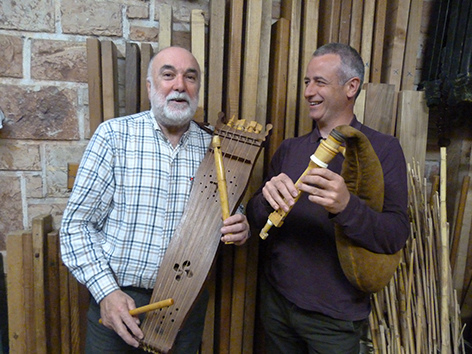
Juan Mari Beltran (xirula, ttunttuna) eta Fernando Jalón (xirolarru boha), grabazio saioan. (Arg.: Soinuenea)
PORRUSALDA
Azkoitiko Monttetarren dultzaina errepertoriotik hartutako porrusalda hau 2012ko ekainaren 2an Soinuenean antolatutako HM Udaberriko kontzertuan grabatu zen*.
Hiru bueltetako bigarren pasarte instrumentala J.M. Beltranek egindakoa da.
Soinulariak: Juan Mari Beltran (xirolarrua) eta Fernando Jalón (dultzaina).
* Beltran Argiñena, J. M. (2004). Dultzaina Gipuzkoan. 1950. hamarkada arte. Soinuenea. 179. or.
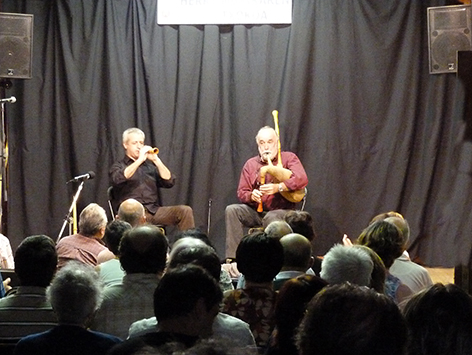
Fernando Jalon (dultzaina) eta Juan Mari Beltran (xirolarrua), HM Udaberriko kontzertuan. (Arg.: Soinuenea)
Txulo. Juan Mari Beltran-txanbela taldea. 1997. txanbela-arinarinketan. IZ 488.
Xirolarrua-boha joaldia. Juan Mari Beltran. Oiartzun, 1998.
Full sheet
- Number:
- 60
- Classification:
- Aerophones -> Reeds -> Bagpipes
- Notes:
- Xirolarrua, bota, gaita de bota


