


Description
The tambourine belongs to the membranophone group.
Description of the instrument
It’s a circular wooden ring about five centimeters wide and with a diameter of 20 to 40 centimeters. Half a dozen pairs of chindas (rattlesnakes) are placed in this ring, in rows of one or two. The ring has a skin membrane on one side.
Way of playing
Most Basque tambourine players, when playing, move very little the hand with which they hold the tambourine, and make the membrane vibrate with the other hand in two different ways: hitting and rubbing.
History
This membranophone that is played with the hands and fingers is well known and widely used in the Basque Country.
According to Father Donostia (1952), a record from the 16th century tells us that Carlos IX, when he came to San Juan de Luz, entertained himself by watching the young women dance. All the dancers carried a sieve with cowbells as a "little drum/tambourine". Another piece of news from the 17th century tells us that on the trip that Madame d'Aulnoy made, upon her arrival in Pasaia, “a boat came out to meet her with fifty companions, each of whom had an oar in the shoulder. They walked in two long lines, and there were three bateleras who preceded the procession, playing the tambourine very well. After Madame d'Aulnoy was greeted, the tambourines began to play louder, gave great shouts and did the rowing exercise, jumping and dancing with very good grace. They dismissed the traveler dancing and singing with their tambourines ”(p. 289).
In the article by Jesús Ramos (1990), in the list of musicians who attended the Pamplona feasts in the 18th century, nine tambourine players appear, eight alone and one accompanying the guitar. Of these, six were from Pamplona, two from Aoiz and one from Laguardia.
The book "Journey through Spain", written by Baron Charles Davilier in 1862, tells us about the 19th century: "In addition to the tambourine, the Basques dance to the sound of the bagpipe, the same as Asturians and Galicians, and with accompaniment of the tambourine and the flute ”(p. 68).
In the article "Erregiñetan, or the festivals of the Mayas", Father Donostia says: "The companions sing to the sound of a tambourine" (Donostia, 1916, p. 4).
It is clear from these documents that the tambourine has been used for a long time among us. Dances like those of that time are still danced with the accompaniment of the tambourine. Furthermore, we cannot forget that in some places abroad this instrument is known as "tambour de basque" (see Grove Dictionary of Musical Instruments).
As we will see below, the tambourine has been part of very varied musical groups. However, it’s also been used alone and accompanied by the voice, that is, a single person has sung and set the rhythm with the tambourine.
In many small towns, dance sessions on Sundays were led by the tambourine, as recounted by the deceased mother of Juan Mari Beltran. At the beginning of the 20th century, as in many other places, in the small Navarran town of Alli, in the Larraun valley, after the religious ceremonies of "vespers" on Sunday afternoon, young people and kids gathered in the back from the church to dance. For the patron saint’s festivities (sometimes also for Carnivals) the txistulari and atabalari were called (at that time the txistulari Xalbador of Zubieta in Navarra with his son playing atabal), but in the weekly sessions on Sundays, tambourine and voice where enough. The older sister of JM Beltrán's mother, Franziska Argiñena from Argañea, was dedicated to it, and taking into account that she was responsible for those dance sessions, and that in them the young people took the path of sin, the priest did not sympathise that girl.
Another example is that of the famous tambourine player Primi Erostarbe, from the Araoz neighborhood of Oñati. Her parents had a bar in that neighborhood and to attract and entertain the clientele, she was seated in a chair on Sundays from a very young age to sing and play the tambourine.
She played trikitixa and porrusalda with the tambourine, as they are played with other instruments. That is, she alternated tambourine instrumentals and verses. She ed off a lot in these interludes, making many variations.
But the tambourine, as we have mentioned, was part of various groups. At the end of the 19th century, the tambourine appears accompanying a txistulari (without tambourine) in an image of a wedding in Bizkaia, leading the line of carts that transport the herding.
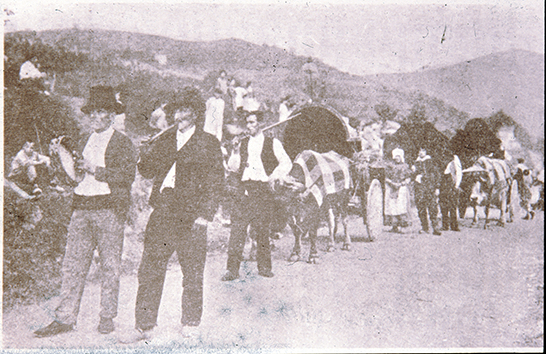
“Boda a la antigua usanza”
(Enciclopedia General Ilustrada del País Vasco. Diccionario Auñamendi. An-Artazu. Arreo. p. 587)
In the rondallas or estudiantinas, the tambourine is played along with guitars, lutes, bandurrias, flutes and clarinets.
In some old photos of Bizkaia, we see it accompanying the violin.
In Bizkaia and Gipuzkoa it also appears accompanying the dulzaina. In Bizkaia we have been able to witness it until recently, and in Azpeitia Father Donostia documented it (Donostia, 1952, p.281).
It has also been common to see the tambourine forming a group with the alboka. In this case, the panderista used to have a double function: to set the rhythm and sing the verses.
Since the diatonic accordion arrived in our land, the tambourine has accompanied it, forming the group that today is known as trikitixa.
Although we find few women who play other instruments, in the case of the tambourine the presence of women is abundant.
Today, the tambourine is still used in traditional Basque music, and we can see that local performers create and maintain rich, varied and high-quality ways of performing.
SOURCES
Bibliography
BELTRAN ARGIÑENA, Juan Mari. (1996). Soinutresnak euskal herri musikan. Hernani: Orain.
DAVILLIER, Barón Charles. (1862). Viaje por España. Tomo III. (Capítulo XX – Danzas Españolas). Colección: “Viajeros por España”. Madrid. 1991.
DONOSTIA, Aita. (1916). Erregiñetan, o las fiestas de las Mayas. Obras Completas del P. Donostia. (Tomo I, 1-11). Bilbo: Ed. La Gran Enciclopedia Vasca.
(1952). Instrumentos Musicales Populares Vascos. Obras Completas del P. Donostia. (Tomo II, 257-309). Bilbo: Ed. La Gran Enciclopedia Vasca.
RAMOS, Jesus. (1990). Materiales para la elaboración de un censo de músicos populares de Euskal Herria, a partir de los instrumentistas llegados a Iruñea en el Siglo XVIII.Cuadernos de Etnología y Etnografía de Navarra (55. zk., 91-138). Iruñea: Institución Principe de Viana.
Discography
ALDEITURRIAGA, Maurizia. (1979). LEON, MAURIZIA, FAXIO. Alboka eta trikitixa. Xoxoa. X-11.115.
BELTRAN ARGIÑENA, Juan Mari. (2017). Soinu-tresnak Euskal Herri Musikan. 1985-2010. Elkar-Soinuenea Fundazioa. KD DVD-E 968.
Filmography
BELTRAN ARGIÑENA, Juan Mari. (2017). Soinu-tresnak Euskal Herri Musikan. 1985-2010. Elkar-Soinuenea Fundazioa. KD DVD-E 968.
LARRUKERT, Fernando. (1978). Euskal herri-musika. Euskadiko Filmategia.
Image gallery


Audio
Pandero joaldia fandango erritmoan. Juan Mari Beltran. Oiartzun, 1998.
Full sheet
- Number:
- 77
- Classification:
- Membranophones -> Beaten -> Tambourines
- Notes:
- Panderoa, pandereta


