


Description
The atabal belongs to the family of the membranophones.
Description of the instrument
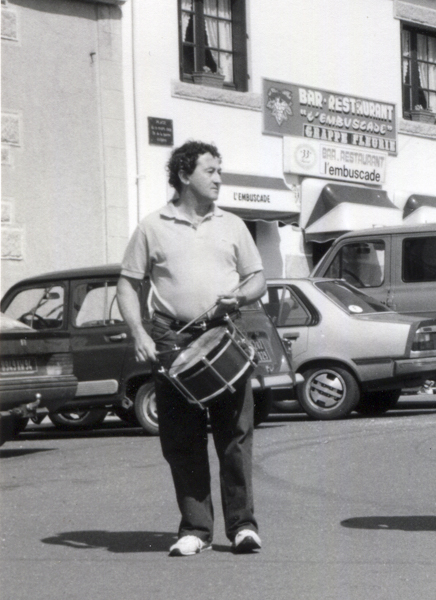
This drum has a cylindrical wooden box with bigger width than height. Both mouths are closed with goatskin. Formerly a rope was used to tighten the membrane; recently a metal rod is mostly used. The atabal has a string (bordón) made of gut or other material against the lower leather to change and increase the sound of the leather.
Way of playing
The upper skin is struck with a stick in each hand. The player performs highly complex rolls and rhythmic games with these two drumsticks, which decorates and enriches the music.
History
These instruments, d in many ways, have given rhythmic support to the txistularis’ and xirularis’ melodies for years.
The atabal player of the txistu group plays with great skill, performing rolls and rhythmic games of great complexity, decorating and enriching the music of the txistularis.
To help the rhythm set by the xirulari with the ttunttun (string drum), usually a atabal player ("tabala" in Zuberoa) also accompanies them. This atabal is a bit big, with a metal box. When hitting, they cover the upper membrane with a coloured handkerchief.
Very often, in the txistularis’ and dulzaina-gaita groups, the caja (used by music bands) substitutes the atabal.
SOURCES
Bibliography
ANSORENA, Isidro. (?). Txistu ots gozoa nola? Lenengo ikastaldia.
(1965). Txistu ots gozoa nola? Bigarren ikastaldia.
BELTRAN ARGIÑENA, Juan Mari. (1996). Soinutresnak euskal herri musikan. Hernani: Orain.
DONOSTIA, Aita. (1952). Instrumentos Musicales Populares Vascos. Obras Completas del P. Donostia. (II. alea, 257-309). Bilbo: Ed. La Gran Enciclopedia Vasca.
EUSKAL HERRIKO TXISTULARI ELKARTEA. (1928- ). Txistulari aldizkaria.
ANSORENA, Isidro. (?). Txistu ots gozoa nola? Lenengo ikastaldia.
(1965). Txistu ots gozoa nola? Bigarren ikastaldia.
BELTRAN ARGIÑENA, Juan Mari. (1996). Soinutresnak euskal herri musikan. Hernani: Orain.
DONOSTIA, Aita. (1952). Instrumentos Musicales Populares Vascos. Obras Completas del P. Donostia. (Tomo II, 257-309). Bilbo: Ed. La Gran Enciclopedia Vasca.
EUSKAL HERRIKO TXISTULARI ELKARTEA. (1928- ). Txistulari aldizkaria.
OLAZARAN de ESTELLA, P. Hilario. (1951). Txistu. Tratado de flauta vasca. Bilbo. 1970.
Discography
ANSORENA, Isidro, Banda de Txistularis del E.A.S.S. (1970). Bailes vascos. Columbia. C 7090.
ANSORENA, Jose Inazio. (1985). Donostiako Txistulari Udaltaldea: Donostiako Txistulari Udaltaldea. Dial Discos. Doblon. 50.1769.
BELTRAN ARGIÑENA, Juan Mari. (2017). Soinu-tresnak Euskal Herri Musikan. 1985-2010. Elkar-Soinuenea Fundazioa. KD DVD-E 968.
BILBOKO UDALETXEAREN TXISTULARIAK. (1977). Bilboko Udaletxearen Txistulariak. Movieplay-Kandantxa. 17.0911/0.
ELIZALDE, Maurizio. (1971). Baztango dantzak 1. HG-24. Baztango Dantzak 2. HG-26.
(1977). Lanzko zortzikoa-jostaketa dantzak. HG-OTS. HG-169.
MAKUSO, Miguel. (1977). Herriko Musika. Movieplay-Kardantxa. 17.0912/2.
Filmography
BASTERRETXEA-LARRUQUERT. (1968). Ama lur / Tierra madre. Euskadiko Filmategia.
BELTRAN ARGIÑENA, Juan Mari. (2017). Soinu-tresnak Euskal Herri Musikan. 1985-2010. Elkar-Soinuenea Fundazioa. KD DVD-E 968.
CARO BAROJA, Julio eta Pio. (1971). Navarra. Las cuatro estaciones. Nafarroako Gobernua. 1994.
(1979). Gipuzkoa. Gipuzkoa-Donostia Kutxa.
LARRUKERT, Fernando. (1978). Euskal herri-musika. Euskadiko Filmategia.
Image gallery



Audio
Barrikada haustia (Zuberoako maskarada). Oihenart (tabala), Mixel Etxekopar (xirula). Gotein, 1999.
Full sheet
- Number:
- 73
- Classification:
- Membranophones -> Beaten -> Stick-beaten drums
- Notes:
- Atabala


