


Description
The kalaka is an idiophone struck in a non-direct way.
Description of the instrument
It is a wooden shovel with a handle. It has two other handleless slats on both sides, tied by two holes with a rope.
Way of playing
It is held by the handle and shakes; in this way, the two outer slats collide with the central one thus producing their sound. It is often played freely, but sometimes also in rhythmic games that are ed.
History
They are used in Holy Week celebrations in various regions of Euskal Herria (Beltrán, 1996), both inside and outside the church, for notices of religious acts (pp. 38-39).
Father Donostia (1952) refers to the kalaka in his article on Basque sound instruments:
"In addition to a mill cytole, kalaka also means a small rattle made of three tablets, about 25 cm long by 10 wide, which is made up of a central wooden paddle with a handle, to which they are attached, by means of articulated wires, two others that move against the central one. It is used on Holy Thursday and Holy Friday at mass, replacing the ordinary bell." (Page 290)
We have received information about this instrument in the Estella and Tolosaldea areas, among others.
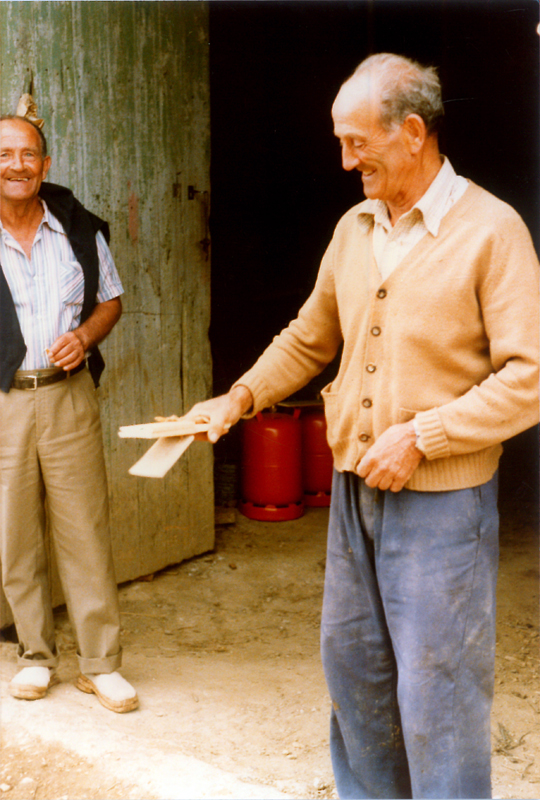
Jesús Unanua playing the compeleta, Ochoa de Zabalegui. Muez, July 1985.
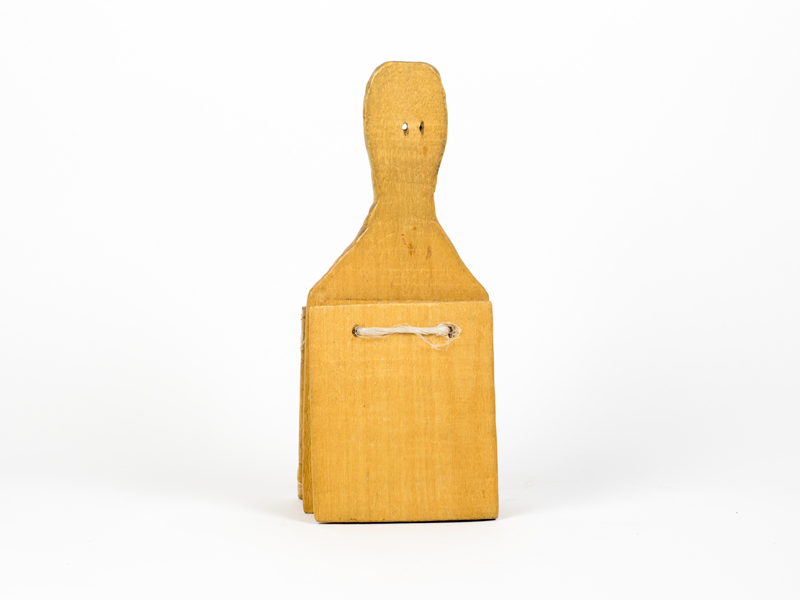
Kalaka made by Jesus Unanua from Muez (Soinuenea-JMBA Collection nº 19)
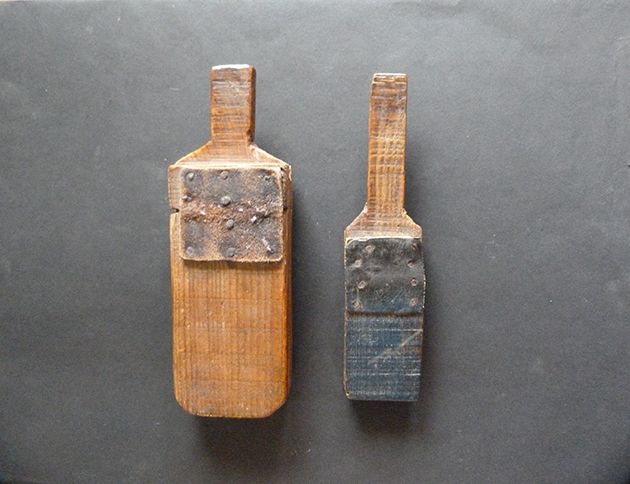
Kalakas from Elixalde-enea, Alegia.
SOURCES
Bibliography
BELTRAN ARGIÑENA, Juan Mari. (1996). Soinutresnak euskal herri musikan. Hernani: Orain.
DONOSTIA, Aita. (1952). Instrumentos Musicales Populares Vascos. Obras Completas del P. Donostia. (Tomo II, 257-309). Bilbo: Ed. La Gran Enciclopedia Vasca, 1983.
ETNIKER. (1993). Juegos infantiles en Vasconia. Etniker Euskalerria. Gasteiz: Eusko Jaurlaritza.
Image gallery


Full sheet
- Number:
- 14
- Classification:
- Idiophones -> Struck -> Indirectly
- Notes:
- Kalaka, konpeleta


